Creighton Stations
Sound-recording objects · Post-industrial folklore · Research in progress
Listening as collection
Creighton Stations is an ongoing research-creation project by Jonathan Carroll, bringing together sound-recording objects, site-responsive listening, and post-industrial folklore. Named after Nova Scotian folklorist Helen Creighton, it asks what collecting might mean when the collector is a small machine that also plays back what it has heard.
The project sits alongside research into industrial afterlives, memory, and the relationship between bodies and land. The stations are not instruments for measuring contamination or diagnosing health: sound is an artistic and situated material, not a substitute for environmental or medical evidence.
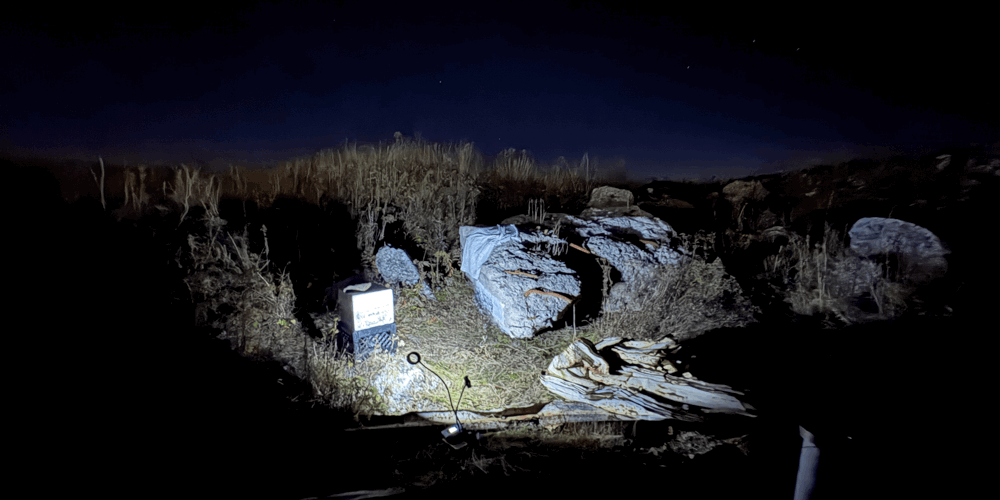
A working question: what changes when a collecting device becomes a participant in the soundscape it records?
Listening, remembering, returning
The recorder/player is designed around a repeating relationship between listening, storing, and returning sound. Playback is probabilistic rather than a continuous replay of everything collected.
- Listen: monitor the microphone for sound above a configured trigger threshold.
- Remember: retain a short pre-roll, record a WAV file to microSD, and stop after sustained silence.
- Return: occasionally play a stored recording through the speaker, then resume listening.
Playback, maintenance, and network operations introduce listening gaps. This is not a gapless recorder, and a recording is not a complete account of a place.
Inside the station
The documented design uses an AI Thinker ESP32-CAM with an I2S microphone, onboard microSD in one-bit mode, and a speaker driven by a bare LM386N-4 amplifier. The camera is unused. Salvaged and repurposed components are a working preference, not a claim that every part has been recovered.
ESP32 PWM → RC filter → volume control → LM386 → speaker
Technical notes and safe handling
- Microphone: BCLK GPIO12; WS GPIO0; SD/DOUT GPIO3 through the programming-isolation switch; 3.3V and common ground.
- microSD, one-bit mode: DAT0 GPIO2; CLK GPIO14; CMD GPIO15. Other socket connections and boot-strapping constraints still matter.
- Audio output: GPIO4 through the filter, volume control, and coupling capacitor to the amplifier. GPIO4 also drives the flash LED.
- Open the microphone isolation switch for programming. Before closing it for recording, remove the ESP32-CAM-MB base or physically isolate its UART output. Unplugging USB alone is not proof of isolation.
These are reference notes, not a complete wiring guide. Use the firmware repository’s current construction and bench-test instructions before wiring or powering a station.
Ways of connecting
Several different forms of connection are under consideration. They should not be read as one completed network.
| Path | Purpose | Status |
|---|---|---|
| Local Wi-Fi | Administration and maintenance downloads near the station. | Experimental firmware committed; compilation and hardware validation not confirmed in the repository. |
| Phone hotspot | Provide internet tethering for periodic HTTPS status reports, not recordings. | Experimental uploader; no deployed receiver or durable offline queue. Battery voltage remains null. |
| QR / Spatial Narrative | Connect the physical object to a location-based web narrative. | Proposed connection to a separate project; not a confirmed station integration. |
| FM / listening hub | Explore audible tone messages and a nearby receiver or collecting hub. | Design proposal only; no implemented FM telemetry or tested radio link. |
Radio as a future direction
A possible extension would let stations send short tone-coded messages to a listening hub. It could make reception, interference, and the act of tuning part of the work rather than hiding communication behind an interface.
A phone might provide processing or internet access, but reception hardware, audio input, software, and power would need to be specified and tested. Station-to-hub broadcasting would not by itself provide a return channel for commands. Spectrum compliance, privacy, signal reliability, and shared-channel access would need review before any deployment.
Development record
- Preserved baselines: the original random-playback sketch and legacy web-admin sketch remain available as fallback versions.
- Experimental branch of the design: the connected sketch adds local administration and configurable status uploads; its repository checklist still requires compilation and bench testing.
- Next documentation: verified build photographs, dated test notes, example recordings reviewed for consent, and explicit accounts of failures and listening gaps.
No deployment location, operating history, or recording is inferred from the photograph. This page does not display live station status.
Documentation sources
Technical status is based on the Creighton Station README. Page layout follows the Jonathan Carroll site conventions. The conceptual framing is draft editorial text for the artist’s review.